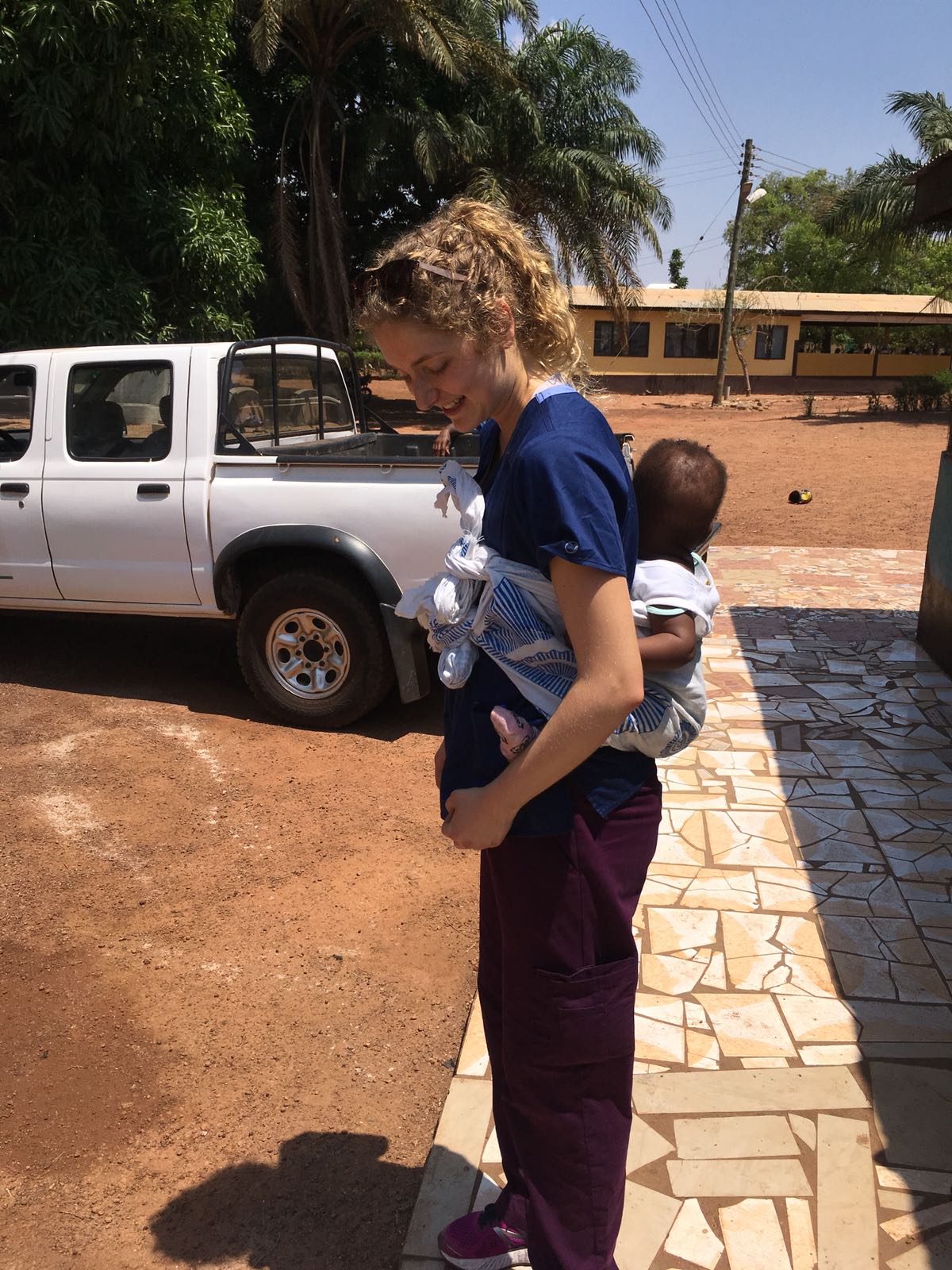
Monday, April 2, 2018

Tamale Accident and the ER

It’s always easier to share the positive things I’m experiencing on this trip. Nothing I’ve posted on my social media has shown the things that aren’t so beautiful, until now. I went from working at the Shakhina clinic, the most peaceful place I’ve ever been, to the Tamale Teaching Hospital where I had my hardest days yet. The three days at the hospital were the most difficult shifts of my nursing degree. However, it’s not all doom and gloom. The shining light in that place was a tall, muscular, brilliant nurse named David. He often didn’t come in ‪until 10:30, but that was the norm. In Ghana, being on time has a completely different meaning then back home. The shifts here are ‪from 7:30am-1:30pm, ‪1:30pm-7:30pm, and overnight ‪from 7:30pm-7:30am (Shorter day shifts due to the heat). Here in Ghana, the staff come when they come and leave only when the next nurse arrives, whatever time that may be. No one seems to be bothered by it either. 
In order to understand the traumas I saw, I need to share a little bit about the people of Tamale. For them, going to a hospital is a last resort. There are other options that are tried first, things like medicine men, juju men, witch doctors, and bone setters. Western medicine isn’t always needed, these traditional services can have some amazing results. I was talking to our instructor Jeanette and she mentioned the research into bone setters was pretty awesome. Another reason people wait to go to the hospital is money, without insurance, everything must be paid for out of pocket and it’s expensive. I also want you to consider the patients are not always treated well by the staff. Back home, learning to communicate and build trusting relationships with patients is just as important as learning the skills, but here that is not always the case. They might be hushed when they call out in pain or scolded for waiting so long to seek medical attention. Now that you have a bit of background, I’ll tell you what it’s really like. 


Day 1
I had been well prepared for this clinical placement. Told what to expect and what I would see. I had made a worst case scenario in my head, but never expected that is what I would be walking into. With our instructor Maggie, Camille and I walked down to dark hall towards the unit. It smelled like a combination of detol, the cleaning solution used here, and urine. Stretchers lined the hallway, and every single bed was being used. There were even people sprawled out on the hard floor of the trauma bay. There had been a bus accident the night before. 
It wouldn’t be uncommon for people to ride on the roof with the luggage.
Traffic accidents are very common in Ghana.

Back home this would be a code orange, this means extra staff and protocols to control the chaos. Here, no one was yelling or running the atmosphere was very laid back, which seemed to odd to me. I was so overwhelmed, walking around wide eyed and not knowing where to start. I’m sure Maggie could sense how I felt, she stayed. 
David met us in the trauma bay and mid conversation his head turned to the door and said “Oh Shit!” My back was towards the door and not going to lie I was a little afraid to turn around. Once I did, I saw a young man covered in blood. He was bleeding from the left side of his head. He was in a motor cycle accident with no helmet. His head had collided with the person on the other bike. We sat him down tried to remove his shirt but it was a struggle, the blood had made it difficult. It was like trying to take off jeans after being pushed in a pool. David put pressure on the wound and wrapped his head as Camille and I tried to do an assessment. Maggie said “what does his heart and lungs sound like?” I’d been so shocked I had forgotten to listen. When I pulled out my stethoscope to listen I remember thinking that I’d never had blood on it before. I’ve never had that much blood on me before come to think of it. Once he was stable, Camille and I left the trauma bay and went to see where we could be helpful. 
A man had come in by ambulance, he was breathing and had a pulse but was unresponsive and had no reaction to pain. His skin was so hot. It felt like he could just burst into flames at any moment. He was triaged as red, critical. 

There isn’t much we could do for him. Even back home with all the supplies at our fingertips. Here supplies were limited. Camille and I did our assessment at supported the family while someone tried to find a bed and move him to the “red zone” on the ward. I knew he wasn’t going to make it.
Another man in the red zone needed the dressing to his hand changed. He had been in the bus accident and his hand was crushed and he was unconscious. It looked like it had been through a meat grinder. I asked if we could get him some pain medicine because I noticed his breathing and heart rate had increased. The nurse said he didn’t need it. She pinched his arm and he had no response. It was only once the antiseptic was poured on his hand and he pulled his arm from her hand did she believe me that he was in pain. We stopped and got an order for pain medicine, but the family couldn’t afford it and that meant we had to keep going. Camille and I watched uncomfortably as she pulled the clots out of the wounds and wrapped his hand in gauze that wasn’t sterile. 
Protocol on how to triage incoming patients
I noticed the doctor starting CPR on the man that was brought in and Camille ran over to help. I was still helping splint the hand after the dressing change and didn’t run over. Camille said the doctor did three compressions and she offered to get the ambu-bag to help him breathe. Finding things on the unit was not easy she asked for help and the nurse stopped to chat with a friend instead of grabbing the bag. Needless to say, we were frustrated. This man is dying and you’re stopping to talk! The doctor called time of death. And then I remembered, this is what the nurses see almost every day. This is their normal.
After that, we helped comfort the man from the motorcycle crash while David stitched him up. (Emerg nurses here have a bigger scope of practice, like rural nurses back home) He was sterile! It was nice to see such good technique after what we had just witnessed. 
Just then another man in the red zone started to choke on the oral airway in his mouth. It was too small. I watched as David pulled out of the patient’s mouth with pliers. I was the one to put the new one in, the correct size is time, with Maggie by my side supporting me.
After this, Camille and I were done. That’s all we could handle for one day. But we spoke too soon, as they needed us to do some teaching before we left. We said okay, and I struggled with the language barrier, trying to explain why it’s important to stay in the hospital with a bone sticking out of a leg. We happened to be next to the family of the man who had just passed. Camille’s eyes met theirs and I heard her say “I’m so sorry” and she had to leave. I felt my heart sink. This was it. Now I was really done for the day and it was only 12:30. 

Day 2

I didn’t really want to come back. I didn’t feel helpful the first day. Camille and I were on our own. We made a good team. I knew I could count on her. 
When we walked in today, there were empty beds! I was so relieved to see that it was a slow morning. We took some vitals in the trauma bay for the nurses. There was one critical blood pressure 220/120 (normal is 120/80). We reported to the nurse and the patient got IV meds to lower his blood pressure within a few minutes. After yesterday, I was impressed with how fast that happened. 
Camille and I found David and went to assess a young boy who had fallen out of a mango tree. He had broken his neck and was paralyzed from the neck down. David found him a neck brace, his neck hadn’t been properly supported until now. Using my finger, I traced a line from his neck to foot to see when he could no longer feel my touch. He could feel everything! This was a great sign Camille and I helped wash him up with the help of two other nursing students. This process took over an hour. Between finding linen, a basin, towels, and all the turning. I noticed that then number one priority around here seems to be keeping the patients clean. 
Just when I thought all was well, in came a man in respiratory distress. He was working so hard to breath. Camille and I jumped into action getting oxygen and doing assessments. The nurse interrupted us and said, “he needs to rest, stop asking questions.” We didn’t stop. He doctors came and ordered a steroid to reduce the inflammation and help him breath. The family member had to run across the street to buy the medicine while he struggled for every breath. 
Just then, a woman was wheeled in also struggling to breath. She looked worse, yet all the doctors stayed with the young man. Camille and I desperately searched for another oxygen mask. We found one, but it had been used so many times the seal was not good. The good mask was being used on the young man. One of the residents came over eventually, we had taken vitals. They were critical. Her oxygen saturation was 64% (it should be above 95% in a healthy individual). We got her a nebulizer to open her airway and a steroid. It didn’t help moments later she stopped breathing and collapsed in Camille’s arms. Her heart stopped Camille started CPR immediately. I had brought over an ambu-bag earlier and I started breathing for her. She started vomiting. The resident hooked up suction and I put in an oral airway. All that was going through my mind was, “Thank God I put one of these in for the first time yesterday. So at least I know what to do.” I was so impressed by Camille, she was running this code. The resident looked petrified. He was learning too and didn’t have support. I don’t think she stopped doing CPR the whole time. We did everything we could with the limited supplies we had, but the resident called time of death. Within ten minutes of being wheeled in she had passed. Camille and I cleaned her up. Camille told the resident he had to talk to the family now. I was proud of her. Usually the doctors do paperwork first but, she made sure this was a priority. This was it. All we could handle for another day. 
All of the equipment we had in the ER
Camille and I left out the main entrance and we’re stopped by the daughter. She hadn’t been with the family when they were told. Camille, without hesitation, told her everything we did and finished with your mom had passed away. She collapsed into our arms. Screaming. Crying. This is not news a nurse would ever have to give in Canada. We held her until a friend came to get her. 
We walked into the parking lot, tears streaming down our faces in silence. I hoped that no one else would notice around us. It was 40 degrees. Maybe I could pass my tears off as beads of sweat. 

Day 3

After a rough couple of days, Camille and I were given the option of not going today. We both felt like we had to be there. 
The night nurse had waited for us to get there to do vitals in the trauma bay again. We didn’t mind. There were also two nursing students from Belgium on the ward today. Yay, I thought, some backup. Camille and I checked on some of the patients we saw yesterday then took a break. On our break we felt that the day was different, it was calm. We even sent a message to our group chat saying………

After choking down another granola bar, Camille looked at me and said “We need to go to the trauma bay.” I asked if her nurse sense was tingling and she said it was. I still don’t know how she knew, but two traumas had just come in. We split up. She went to the head trauma and I went to man struggling to breath. The resident asked a student to bring over a screen to do an assessment. Not again. After three days here I was feeling ballsy! I broke protocol, I told the doctor we’re going to the ward and he can do an assessment there. He needs oxygen, now! While I had to hunt down a mask, clean it, and hook it up, the resident put in a Foley catheter. Ugh! Interesting choice. The basics are the CABs: circulation, airway, breathing. Not urination. 
resuscitation is number ten on the to do list here
Now that the oxygen had helped him breath better, it was time to focus on his blood pressure. It was 65/40(normal is 120/80). This is a critical low. He was bleeding from a peptic ulcer in his stomach. He was in shock. Camille was back now. We took turns sealing the mask to his face, but the doctors had a plan: “Fluids and lots of them. Then to the operating room to stop the bleed.” His brother came by crying and I gave him a hug and let him know what we were doing. This man was young maybe a little older than me. The fluids were taking too long, Camille ran to the pharmacy herself and make them give her bags of normal saline. She put her name down to be billed later. We kept him breathing and running fluids for a couple hours before Maggie, Jeanette, and Vida walked in. They had been saying the official goodbyes and all the other students had left the hospital for the day. Their nurse senses were tingling too and they felt like they needed to check on us. At this point I was in over my head. His oxygen tank had emptied and it had taken 5 long minutes to switch it over to a new one, all while I watched his oxygen levels drop. Hour three, still waiting for the OR. Maggie tagged in holding the mask and decided to stay. I’m so grateful she did. Camille and I were so frustrated at this point. Camille had run to the pharmacy again for fluids and I had paid 5 cidis out of my own pocket for a glucose test strip. 
All of the fluid hadn’t increased his blood pressure. His abdomen was becoming more and more distended. The resident got an NG tube into his stomach to try and suction out the blood. It wasn’t working. It had been too long. David was by our side now. The man’s lungs started to fill. His heart stopped. Maggie instinctively jumped on the bed she straddled him and started compressions. Camille had the ambu-bag and started breathing for him. I grabbed an airway and David put it in. He yelled at Maggie, “Too many compressions! Take a break!” David, Maggie, Camille, and I took turns doing CPR. This was the first time I’ve ever done CPR. The first time I pressed down on his chest, it was such an awful feeling. I wasn’t pressing nearly hard enough. I heard Maggie yell “Deeper!” so I did, I pressed harder. It felt like each rib had broken off from his sternum and I could feel the bones grind with every compression. David yelled for epinepherine. One of the Belgian nursing students started to walk to the pharmacy. Maggie screamed “RUN!!!!” After the epinepherine, we got a pulse back. I was ecstatic. I was the one on the mask. With his heart beating I gave him a breath every 5 seconds. This didn’t last long his pulse faded away and it was back to CPR. The blood oozed from his nostrils, mouth and out of the tube that had been placed. We had an audience. In the quiet ward here were three white women yelling and barking orders at people. I’m not usually one to yell but when one of the other students attempted CPR it looked like she was just slapping him in the chest. Maggie tried to coach her, but it wasn’t working. Every second counts now. I shouted “NO” and shooed her out of the way. It had been thirty-five minutes, decision time. Maggie asked for a decision and the resident called it. 
When I saw the brother after he was smiling. I thought it was the weirdest reaction. He shook my hand and kept saying thank you. Maybe he had watched how hard we tried. No way to be sure. This time when I said we did everything we could. I meant it. 

Witnessing death every day was awful. I don’t know how the nurses do it. It’s nurses like David that I’m in awe of. He works so hard every day, with limited supplies and hustles in an environment when it’s acceptable not to. I learned a lot about myself. I know more then I think I do. I loved seeing how creative they are with the things they do have. I’m so thankful for Maggie and Camille. I couldn’t have asked for better teammates. 

Rachel, David, Albert [head nurse and awesome too], and Danielle
Tamale Teaching Hospital was where Camille and I tried our best to save a life, and we did the best that we could with what we had.

***Don’t worry Mom and Dad we are coping well and heading to Mole to rest and recover! 


Written by Krista Koenig, UBCO 4th year BSN student

Thursday, March 29, 2018

Fly on the Wall....


My recent experience in the Tamale Teaching Hospital, more specifically on the labour and delivery (L&D) ward, was very mind-opening. Having only been exposed to L&D care for one day last year at Kelowna General Hospital, I felt like I had walked onto a ward where I was only qualified enough to be a fly on the wall. Luckily, for the first day that’s all my partner and I were – flies on the wall. Huge-eyed, stunned-looking flies as our brains were trying to take in and process as much as our eyes could let in at once. 
Labour & Delivery Ward

Garbage Bins
The delivery room is empty when we first arrive, which is apparently quite rare. We find this to be true in the subsequent hours and days as they average 25 births per 24 hrs (both vaginal and cesarean deliveries). The “Stage II” room (active labour/delivery room) has six beds in it, each only about three feet from its neighbor. The room is hot despite all of the windows open and the two old ceiling fans twirling. The air is thick and I can feel it on my skin, but maybe this is just in my head. The smells vary depending on how many soon to be mothers, women currently becoming mothers, already mothers, or recovering mothers there are. It’s not hard to imagine though, since each bed has a garbage basin sitting at its feet that collects (or at least tries to) all of the less romantic part of the birthing process: amniotic fluid, broken water, urine, stool, meconium, and blood. The room is not air-conditioned and they say it never gets below 30 degrees Celsius here this time of year, today it’s 39C outside.  

Needless to say, it’s a bit different here than in Canada.

We meet, and befriend, a couple of midwifery students on the ward. This is appreciated because I feel less intimidated to ask them questions about what’s going on and their English is great. Actually, all of the staffs’ English is great, but sometimes it’s hard to understand their beautifully thick African accents when they are speaking quickly and with purpose. Everyone’s first language is that of which is spoken in their region (or tribe) and their second language is English which they learned in school. Different regions have slightly different accents when speaking English and it makes my brain go into overdrive throughout the day trying to understand what is being spoken around me. I think it’s so cool that everyone has a mutual secondary language they communicate in.

A woman dressed in a brightly patterned dress-wrap waddles into the room, carrying her own IV bag in one hand while the other is holding her lower back. Her face shows pain that she’s never felt before and yet she doesn’t make a sound. Being stoic is highly valued here and laboring mothers are often given grief if they are making too much noise while pushing a new life into this world. Sweat is dripping off her chin onto the bed as she tries to figure out how to get on top of it and over onto her back with the feeling of something the size of a softball between her hips. The midwife who is preparing to help the mom deliver the baby is getting her gloves on and opening the catheter to insert without any explanation, urethral cleaning, or lube. She is wearing Crocks that are two sizes too small with bare feet inside – the most common footwear in the hospital. The mother was sent down to this room because she is fully dilated and the baby is on its way. It doesn’t take long for me to see the baby start crowning while mom continues to quietly push with the exhausting contractions. The further down the baby comes, the more pain the mom is in and she starts grunting or screaming with her mouth still closed. At one point she holds out a hand in hopes of someone grabbing it, but instead another midwife comes over and moves mom’s hand down to the bed and tells her to quiet down and keep pushing. By observing other people in the room, I started to understand that this wasn’t emotional abuse, but rather just part of their culture; being independent and stoic. Did I mention that 99% of these women give birth without any pain medication?

Needless to say, things are a bit different here than in Canada.

The baby is pushed out and flopped onto a soaker sheet on mom’s chest – almost skin-to-skin, but not quite. The new mother is exhausted and can hardly bother to hold her baby. Sylvia, the nurse who had us under her wing, came in and right away spotted that the baby wasn’t skin-to-skin and took the sheet out from between babe and mom. There, that’s better. This gives baby recognition of who mom is, introduces immunity to the newly extra-uterine human, allows him to be colonized by the same bacteria as mom, and helps with temperature and heart rate regulation. It also gives mom a rush of oxytocin to stimulate uterine contractions to expel the placenta, helps with clotting and reduces bleeding, and tells mom she’s got to get her breastmilk ready for babe. The midwife takes the same
catheter as before out of the basin of (now bloody) water and re-inserts it into the mother, again, with no cleaning or lube. Mom is now ready to get a bit of lidocaine and get her 3rd degree tear sutured up. Watching this made me flinch too, it almost looked more painful than the birthing process. Baby is wrapped up and placed in a basin along with other newborns under the window.

I quickly notice that after delivering, the mothers are either told to walk down to the recovery room to wait or they are kept here for observation if a post-partum hemorrhage (PPH) is anticipated. Delivering babies is a bit like a fast food place down here; they’re ushered in and out as quickly as possible. It’s efficient and resourceful, seeing as how they are often short on staff and are trying to do the best they can with what they have.


Needless to say, things are a bit different here than in Canada.

Sylvia tells us to check out the Theater, the operating room where back to back c-sections are done throughout the days. We need a face mask and hair net to get in and join the other 20 people in the room. The door is often left open and many of the masks I see are not covering either the user’s nose or mouth. Two staff members are sporting bare feet in flip-flops. A few flies are playing around the large brown belly sticking up from a sea of turquoise cloth on the operating table. The baby hasn’t been taken out yet. Despite the lack of resources and equipment, the surgeons do their best to practice sterility once they are scrubbed in. Boiling water is being used to rinse tools, one of the surgeons is wearing eye protection, and four students suddenly jump out of the way to semi-avoid getting doused by a projection of amniotic fluid and blood when the uterus is entered. Three minutes later the baby’s feet stick out – I piece together that mom is having a cesarean because the baby is breech. The surgeon pulls on the baby’s feet, then legs, then reaches up inside to scoop out the head. The baby is very pale and almost grey-tinged. I naively wonder if this is the color that most Black babies are in their first minutes of life, the first one I saw was only a few minutes ago. The babe’s head has a funny shape to it, a shape that I thought was only common with vaginal births because it has to squeeze through the small birth canal. There is no crying, even when the midwife is drying him off and stimulating him. There are a few whispers from the other students as we all watch the midwife feel for a pulse. After a few seconds she takes a cloth and wraps the cold tiny body up to show mom.


My three days at TTH went by quickly and I experienced and learned a lot more than I could have asked for. I saw into some women’s (potentially) most difficult moment of their lives after losing a child before even being able to hold him or her. I also saw some precious moments where mom looks into her newborns eyes for the first time and smiles. There were ups and downs to each day I was there.

Here are some of the things I was privileged enough to witness. (I use the word privileged carefully. I don’t mean to say I was lucky to see these things, but on a global, mind-opening, world-understanding scale, I believe myself to be privileged to now have this insight.)
·       12 vaginal deliveries and the traditions and cultural aspects that come with these.
·       5 cesarean births and the rituals, chaos, and composure of the OR.
·       3 term stillborns and how the mothers and staff deal with this. I was surprised to see that the body and placenta are placed in a cardboard box (typically an empty equipment box) and left on the floor of the room until mom is ready to leave. She will then take this box home and give both her baby and placenta a proper burial when she is ready.
·       A spontaneous abortion of 15-week-old twins fetuses.  
·       A post-partum hemorrhage (PPH) where the mother was getting cleaned out of many clots and what appeared to be a lot of blood. This process also looked more painful than the delivery itself. Blood products are not abundant here so it’s up to the nurses and midwives to do the best they can.
·       A PPH that was being managed by inserting four condoms full of water into the vagina to apply pressure to the bleeding sites to assist with clotting. The mother was to lay there for 24 hours with the four metal clamps hanging out from inside her.

And here are only some of the things I learned:
  • How resourceful the staff members are; they need to be due to a severe lack of supplies, equipment, and financial aid.
  • How the ball can get slowly rolling by continuous advocacy – skin-to-skin!
  • Culture is a beautiful thing. I really appreciate learning about it and find it so fascinating, although sometimes hard to witness. But, just because it contradicts my own culture and beliefs does not make it wrong. It just makes it different. And makes all of us different. And unique.
  • How welcoming everyone is here and willing to share what they know.
  • How to be left alone with my school partner to keep a brand-newborn alive while they are suturing up mom’s belly right beside us. Oxygenating, suctioning, warming up, and stimulating baby for about 45 minutes until he finally gained enough energy to start to fuss and eventually even cry (probably the happiest I’ve felt to hear a baby cry).
  • That babies are cute. But I guess I already knew this…

Posted by Janelle Greer, UBCO 4th year nursing student.

Monday, March 26, 2018

Under the Mango Tree.....


Our first week of clinical, half of us were at the Tamale Teaching Hospital, and the other half at Shekhinah Clinic that Dr. David Abudulai opened in 1991 to serve the poor and destitute. Upon arrival, you see two big mango trees on either side of the entrance, and underneath the left hand side is where Dr. Abdulai performed his first surgery. 
Where it all began....under the mango tree.
Maggie, Krista, Michelle and Tameka with Charity
The energy from the entrance alone makes a person feel not only welcomed, but also humbled. After a tour of the whole property we had three options of where we could volunteer: the OPD (out patient department), the pharmacy/dispensary, and the kitchen. At the OPD, two volunteers in the morning start by giving out ‘medical cards’ which consisted of the person’s name and today’s date.  After they received this, they formed into a line for us to take their blood pressure and pulse. One student was doing the assessments while the other transcribed the patients name and their community into what was the clinic’s book keeping. They see anywhere from 30-50 patients in a day. These patients travel to the clinic from near and far. For those patients who travel far distances, the clinic has small guest houses for them to stay at, as well as providing them three meals a day. For example, If they arrive on Monday, they will be given a number and told to come back the next day. On the Tuesday, they are asked to help clean up the property to maintain its grounds. Then on Wednesday they are able to sit in the lineup at the clinic and be seen by the volunteer doctors. Normally there are two working who will see all patients and write prescriptions that they can go fill for free at the dispensary.
Dispensary
Once at the dispensary, the patient will hand the volunteer their ‘medical card’ from which their blood pressure, pulse, and prescriptions are written. The volunteer will then write the medication name, and draw circles if the medication is to be taken once daily, twice daily, or three times a day onto an small envelope as not every person can read. Each medication has its own separate envelope. The dispensary is small with many shelves labelled for medication types, along with bottles all over the counter. 

The third place students were able to volunteer was in the kitchen. On all three days, each student participated in making and bagging food. On Wednesday, I helped prepare Kenkey, which is a traditional Ghanaian dish. 
Rebecca and Michelle
 

It looked like mashed potatoes wrapped in corn shucks. Along with making meals, the Shekhinah clinic also offers a food program that was started January 6th, 1992 and has run every day since. The food program was started to ensure those who are poor or mentally ill still received food and water daily. Dr. Abdulai himself grew up poor so this was extremely important to him to give back and support those who can not support themselves.  The food is loaded into the back of a pick up truck and it drives through Tamale every day, serving homeless and “mad people.” This is the Ghanaian term for those suffering with mental illness. 
Shannon, Rebecca and Thomas with the food truck
There is not enough words to describe the energy and feeling you have when volunteering with this clinic. This clinic is solely run off volunteers and donations. The joy and happiness that radiates throughout the staff, in-patients, and-out patients is so beautiful to witness. You can feel the love and support  that everyone has for each other, it truly is remarkable. 

Dr. Abdulai's grave
Dr. Abdulai passed away at the end of 2016 after battling cancer, but his legacy of the Shekhinah clinic is thriving more than ever.  The Shekhinah Clinic for the Poor and Destitute has very powerful yet simple goals, “Shekhinah Clinic for the Poor and Destitute aspires to be a source of light, hope, and joy for the poorest of the poor in the society in  order that they may experience God’s free and unconditional love. The clinic exists to provide 
services: medical care, shelter, meal, clothing and other support services to the poorest of the poor freely and unconditionally purely for the love of God and neighbour and depending solely on Divine Providence.” 

All of us are truly grateful to witness and experience the amazing work the Shekhinah clinic offers. Their work touches so many lives within the community and inspires those around the globe. 


Mission Statement


~ Posted by UBCO 4th year BSN students Rebecca Wheatley & Tameka Coulombe

Saturday, March 24, 2018

The Golden Coast


I have come to the Golden Coast
Where poverty and beauty go hand in hand
Here I stand like a beacon of white light
Amongst the dark chocolate tones of the people

Welcome to Ghana

I have come to the Golden Coast
Where the blazing sun saps my strength
Here I stand splattered in freckles and sweat
Wishing for colder nights ahead

I have come to the Golden Coast
Where the church hymns sing joy deep into your bones
Here I stand amongst colorful African prints
Surrounded by smiles and curious looks

I have come to the Golden Coast
Where the woman carry baskets on their heads
Here the mangoes are sweet and goats wander the streets
And in the morning I awaken to the roosters crow

I have come to the Golden Coast
Where there is a place that the mad people are not hungry
I have stood in the shade of the mango tree
Where the flame of the Shekinah clinic was first lit

I have come to the Golden Coast
Where time is not written in stone
Here the people speak in many different tongues
And neither faith nor religion is cause for dispute

I have come to the Golden Coast
Where they say the land wears shimmering red dirt
I have come to see, to smell to taste
To breathe in all of Ghana

I have come to the Golden Coast
Where the swirl of beauty and tragedy are hard to distinguish
Here I stand; often uncomfortable and uncertain
And some days I do not know why I have come

I have come to the Golden Coast
Where the needs are great but the means are not
Here I stand, a stranger in this land
That has forever taken a piece of my heart

Thank you Ghana
Posted by Camille Galloway

Sunday, March 18, 2018

And so it begins...Elmina Slave Castle

Elmina Castle
We started our trip off in Accra, spending two nights in the New Haven resort, trying to get our bearings on the heat and dousing ourselves in bug spray which inevitably slid off of our skin due to so much sweat. Accra is an extremely busy, hot, and loud city, with so many sights, colours, and smells. Then we made our way down to Cape Coast, taking a bus with intermittent periods of AC (when none of us could handle the heat any longer). We did our first group road pee and laughed as people passed us in their vehicles, honking their horns. As we rounded a corner, the shoreline of the coast caught our eyes as the turquoise waters of the Atlantic crashed into the beaches which were lined with hand made canoes. Then, a beautiful large white building standing alone on a point took my breath away. I knew what it was, and so many emotions flooded over me, sadness, anger, fear. This is Elmina Castle, once a haven for cultural segregation, torture, and unspeakable atrocities, now a heritage site, the oldest and largest standing building connected to the Trans-Atlantic slave trade.

For those of you who don't know why this particular castle has anything to do with Global Health, let me attempt to paint you a small picture. In the early 1400's Prince Henry of the Portuguese heard rumours of the Ghanaian people trading in precious goods such as gold and ivory. Because of this, the Portuguese decided to explore West Africa by boat and land and found what would be later called "the Gold Coast". In 1482, Elmina Castle was constructed and used as a trading post by the Portuguese, though not without resistance from the local chief at the time, Nana Kwamena Ansa. For the chief knew that "friends were to be better friends if they were not to live together but would see each other occasionally." Most of the items that the Portuguese brought to trade were guns, gunpowder, liquor, iron bars, etc. Later however, the walls that contained such items, would hold something much more sinister and cruel. The castle itself passed through many hands (Portuguese to Dutch to British), yet all of those hands played a large role in the Trans-Atlantic Slave trade which started with the Portuguese using local tribes to capture their enemies (other local tribes at war with one another) and bring them to the castle by force to be sold and shipped off over the Atlantic for slavery. During the next 400+ years, people were brought into this "castle", chained to it's floors, tortured, raped and starved.

Slave Dungeons
 We had a tour of the majority of the castle, where we walked into the hauntingly dark and eerie chambers of both the male and female slaves. All of these chambers were on the bottom floor of the castle, and most had very little light with very little ventilation. Here they were held until a ship arrived to take them away to a distant and foreign land. That is, if they made it out of the castle alive. The day we toured, it was 39 degrees Celsius, with roughly 80% humidity. The moment we stepped inside these haunting chambers, every single one of us had sweat dripping over every inch of our bodies. This is not an exaggeration. I felt beads of sweat dripping down my legs as if I was peeing my pants. Now imagine being in this stagnant heat with no food or water, and then imagine being cramped in there with hundreds of people, all of which are urinating, defecating, and vomiting on that very floor you are meant to exist on, because they are too weak and sick to drag their bodies to the corners of the room where buckets were placed for them.

Room of the Condemed

Then to add insult to injury, imagine as a woman, the blood from menstruation added to those floors, or being chosen by the governor to be "prepped" and washed to come to his bedroom. And what if you refused or put up a fight? Prepare yourself to be tethered to a cannon ball in the middle of the exposed courtyard for the rest of the females to see. You are now an example of what will happen to you if commands are disobeyed; death by heat with hundreds of eyes peering sorrowfully at you, helpless. For those males who resisted, you are marched to a room painted with a skull over the doorway. Ominous, yet accurate, no person who stepped into that room, stepped out again. A room with absolutely no airflow, was an incubator for death. The walls are etched with claw marks, made by those who would eventually succumb to their fate.
 
The View
 Now these are only some of the injustices that occurred within the walls, not to mention what happened outside of these walls. But for now, I will remain with Elmina Castle only. To the second and third floors of the castle was an extreme juxtaposition, where every room was airy with multiple windows from all directions giving way to the most beautiful breeze that would curl and wrap its coolness around your body like a welcomed hug. Looking out of the windows was like a dream, where you could see miles of white beach and rock being shaped and molded by turquoise waters, crashing here and there. It was as if we had stepped into another world, a resort even.
Door of No Return

If it weren't for the horrors occurring below my feet, I would have liked to stay here. These floors of course, belonged to the soldiers, and the governor who ran this castle; treated as kings while they performed heinous acts against humanity. The clincher for me was the fact that the church where they worshiped, danced and prayed, located on the second floor, sat directly over top the slave chambers where people were in extremely poor health, sick, and dying, waiting to be led to the "door of no return", the single door which millions of slaves have passed through over the years, the door which was literally the one and only exit for these people, the door that sealed their fate; off to the ships they go.


You may ask why I think all of this information is important if not relative to global health? We need to know our history. No matter the colour of your skin, no matter where you come from, this is the world's history, and to not acknowledge it is an extreme disservice to yourself and those around you. This plaque was erected at Elmina Castle which serves as a reminder to never again treat people in such a way, as if they are not human.


Now I bring this back to Global Health. This treatment is still going on today, whether we want to admit it or not. It may be in a different context, but regardless, it is still happening. If you can't think of where people are being mistreated, shipped off to unfamiliar lands, fleeing their homes to seek refuge, or living in squalor because of oppression (specifically high powered oppressors), then please pick up a newspaper, or research on the internet, or watch the news (but please choose a reliable source). This is happening all over the world in plain sight. Because of this, our global health is suffering. People are starving and do not have adequate access to things for basic needs. They are being abused in more ways than one, some of the abuse as subtle as a taunt whispered over the wind, reaching it's intended target. Some is outwardly shown as physical violence, bombing in streets, destruction of neighborhoods, lives, and cultures. Global health involves all of us, we are citizens of this earth! This blog was a minute synapse of what has happened in the past, but the effects are still widely felt, on a global level. So please, do the world a favour, do your part, and be kind to your brothers and sisters. Offer a helping hand when you see someone is struggling, lend an ear to someone who needs it, find compassion in something you would never have seen before. Open your eyes, ears, and heart.


Blog post by Hailey Hunter, 4th year BScN


Most of this information was based on my memory of the tour, however the dates and facts were retrieved from Ashun, A. (2017). Elmina, The Castles and The Slave Trade. Elmina, Ghana: Nyakod Printing & Publishing Co. Ltd.

Friday, March 9, 2018

We're packed and ready to go....

We're off on another Global Health Practicum in Ghana, West Africa.  My colleague Maggie Bannerman along with 14 BSN students head out on Sunday.  We've been preparing since the fall, and I've spent the past week in seminars with these amazing nurses, refreshing what we know about global health and citizenship, power and privilege, colonization, tropical diseases and low resource settings.  Our heads and hearts are full!!

I know the next 5 weeks will be filled with joy and sorrow, hope and despair, and I also know these 14 women will come home forever changed.  

We invite you to share our journey.  It always feels good to know we have support at home. 

And so it begins...