Monday, March 20, 2017

Tamale Teaching Hospital- NICU

Skin to Skin


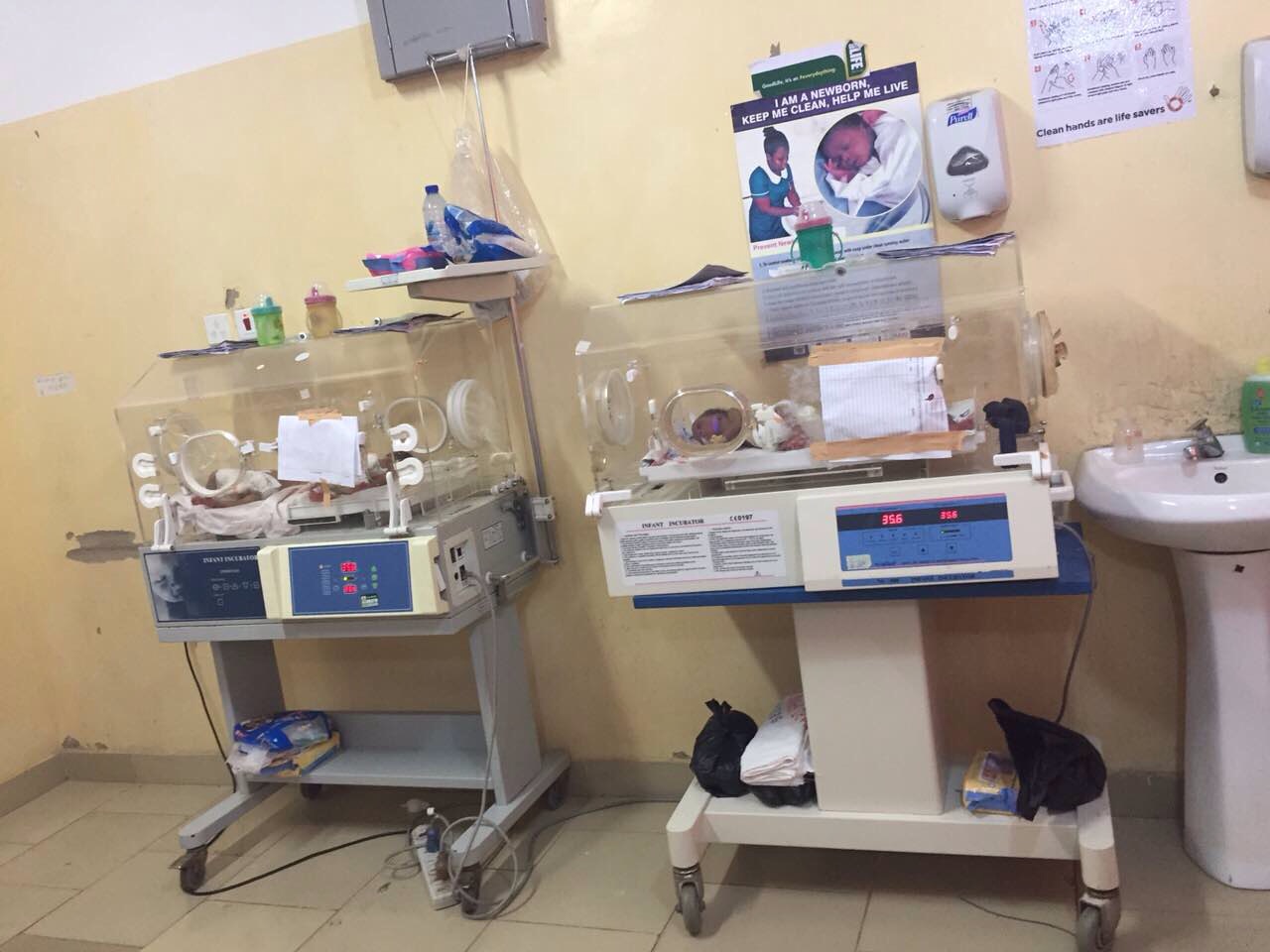
Last week we had the opportunity to work alongside the nurses and doctors in the Neonatal Intensive Care Unit. It was an eye opening, rewarding, and challenging experience for the three of us. We saw the tiniest and sickest babies imaginable. Although the NICU looked much different than our's does at home, the same principles were applied, with much more resourcefulness and creative thinking. These nurses individually take care of as many babies as approximately four nurses would in Canada. The infants are very sick with complex care needs. In the critical care unit, there were 19 babies, who each needed to be fed and given IV fluids every 2 hours. At times, there were as few as 2 nurses in that room trying to manage the workload.

Incubators
The doctors do rounds on every neonate each day to reassess their needs and plan for discharge so that the babies can be home with their families as soon as possible. We were surprised by the advanced nature of their equipment and supplies. They had incubators similar to the ones that we use at home. However, there is a high need for the resources, and a limited amount of supplies leading to multiple infants being cared for in one incubator. Ideally, the incubators should house one infant at a time, to provide an optimal environment for their healing, as each child has specific requirements .

In addition to the critical care room, there was a Kangaroo Care room, and an "open crib room", where the neonates who were almost ready to be discharged stayed. In the Kangaroo Care room, skin to skin and the teaching regarding its importance was practiced, as well as breastfeeding, and tending to their infant's needs. The language barrier was difficult and there were many things we wished we could have shared with the moms and were unable to do so effectively. The staff were very receptive to feedback and suggestions for improvement which was encouraging to us. We felt that our knowledge and opinions were valued and allowed for us to feel like we contributed something important. We are thankful that we received such a warm welcome onto the floor and for everything we learned and were able to teach. 


Posted by: Stephanie Bandura, Amanda McCrate, and Harveer Pooni


Sunday, March 19, 2017

Labour & Delivery at TTH


Six of us nursing students were excited to hear that we all got our first choice placement in the Tamale Teaching Hospital on the Labour and Delivery ward. We spent a total of four days on the ward, observing, learning, and helping with the deliveries as well as monitoring mothers pre- and post-partum. We weren’t sure what to expect when arriving on the L&D floor, except we knew it would be nothing like what we had seen in Canada. We were impressed with the size of the Tamale Teaching Hospital, and felt very welcome by all of the staff on the L&D ward. We wasted no time jumping in and involving ourselves in the deliveries and with the care of the women and babies. We spent time collaborating with the doctors, midwives, and nursing students, as they have the most active roles on the floor. Each student had the opportunity to work with the midwives through several deliveries. We were also able to observe a couple of C-sections, for twins and for triplets. The triplets were conceived via IVF which we all found surprising since the average Ghanaian woman gives birth to 7 children (in comparison to 1.5 in Canada).  We learned about many differences between delivery practices through observation and through talking with some local 3rd year nursing students.

Here are some of the comparisons between Ghanaian deliveries and Canadian deliveries:

1. In the hospital, it’s the midwives who deliver babies instead of doctors, whereas in Canadian hospitals it is almost always doctors.
2. The delivery room consists of 9 labour beds with no curtain, in comparison to individual rooms.
3. No family was present for any of the deliveries that we witnessed, in comparison to partners and families being present in Canada.
Delivery Room
4. None of the women that we asked had picked out names for their babies prior to delivery – they all waited up to a week to decide (traditional customs such as day-of-the-week and tribal traditions play a large part in naming babies).
5. Lack of supplies was very apparent, but we found the midwives and nurses to be extremely innovative and resourceful with the supplies that they did have.
6. We noticed the women were more stoic and quiet during their contractions and labour, and received less pain medications and no epidurals.
7. Often due to ultrasound unavailability, the mothers are unaware of how many babies they are delivering until first baby is delivered and the second baby’s head is visible (we were able to witness this).

We were very inspired and in awe by the strength and resilience of the women in labour, and the healthcare team that helped them along the way. It has been an incredible experience being able to collaborate with the Ghanaian nurses and midwives to provide the personal touch and relational practice we have learned throughout our nursing program. In turn, the Ghanaian healthcare team showed us how to be resourceful and innovative.


Posted by: Mikaela Noble, Kenya Mokoena, Danielle DeYagher, Rebecca Ellis, Carmen Morgan, Kelsey Bellerive

Thursday, March 16, 2017

Cultural Orientation at UDS

Yesterday we visited the University of Development Studies (UDS) to meet Dr. Nafiu Hamidu, the Dean of Allied Health Science, Dr. Thomas Azongo, the Head of Department of Nursing, and Dr. Kofi Glover who provided a lecture on Culture. Dr. Vida Yakong, the Head of Department of Midwifery, accompanied us to the University.

We were warmly welcomed by each person we met during our time at UDS and had the opportunity to experience a unique lecture that enlightened each of us in many ways. During the opening of Dr. Kofi’s lecture he explained to us that each Ghanaian name has a meaning, and that people “come by their names, rather than being given them”. For example, Kofi is a name given to a man who is born on a Friday. We thought that this was unique and allowed us to gain an understanding of the significance of names within Ghanaian Culture.

Dr. Kofi Glover
“You can see, but not perceive, you can hear, but not understand.” This quote by Dr. Kofi explains how we can go through life paying attention to the things we encounter, while at the same time not challenging our thoughts and asking why something is the way it is. Often, the reasoning may be greater than our knowledge. This situation encouraged us to be curious, mindful, and open to learn new things. There are times where what we perceive to be true, is not a universal truth, and we must be open to other perspectives to gain an understanding of all views. Dr. Kofi explained how the Ghanaian faith is so strong, that many believe they have “already found the truth”, and therefore some people may not be as willing to search for answers outside of their religious beliefs. Learning about this helped us to understand the reasons behind some of the major health disparities in Ghana. As Canadian nurses, we cannot simply impose our beliefs on our Ghanaian colleagues and expect them to be useful. Instead, we must collaborate, ask questions about their needs, and work together to find solutions.


Lecture at UDS
During the lecture, Dr. Kofi said the word “polygyny”, and instantly many assumed that he meant to say polygamy and had mispronounced and misspelled the word. He began to explain the meaning of polygyny and how it is quite different from polygamy. The definition of polygamy is that it is acceptable for both genders to have more than one spouse at the same time. While polygyny means that a man can have multiple wives, but the woman can not do the same. In Ghana, some groups practice polgygny, while polygamy is not as culturally accepted. Our initial reaction is an example of how we often assume that we have all of the answers, or even that our knowledge is superior. We were fortunate to have had this lecture to open our minds and to inspire us to value and appreciate the knowledge that others can offer us.

- Posted by Stephanie Bandura, Amanda McCrate &
  Kenya Mokoena

Tuesday, March 14, 2017

A Day at the Pool

Ghana is hot! It is a stark contrast from the snowy pictures we are receiving from our loved ones back home. Currently it is 43 degrees, so we decided to cool off. Past groups have gone to the Volta River Authority pool, so we did too! Our Ghanaian colleagues, Clifford and Francis, took all 18 of us to the pool for a quick dip. Carolyn even got to ride Clifford's motorcycle on the way there! Upon arrival, we quickly noticed that we weren't the only ones with this idea as the pool was full. There was a large and a small pool. There was lots of energy surrounding the pool as there was upbeat music and people dancing.

Jade, Jessica, & Emma at the pool
 Why aren't our pools like this? Even in Canada, a group of 18 women will turn heads and as we were walking into the entrance it was very clear that this was no different. We noticed right away that the pool was predominantly young Ghanaian men in their twenties. We later learned that the women that were there, were girlfriends/wives of the men present and that single women do not usually go there. Clifford and Francis were hesitant of letting us loose into the larger pool as
it was so full, so we decided to go into the
smaller pool. Instantly the kids were intrigued and excited that we were there and they began to show off by splashing around.

Amanda Mc & Andrea with some little kiddos
We all made good connections with the kids by showing them how to swim and by playing games. We were then quickly approached by curious young  men who asked us where we were from, if we liked Tamale, if we were being treated well, where we were going, and what we are doing in Ghana. Their interest was genuine. We were serenaded by a reggae rapper who then offered us salsa and drum lessons at his local studio. As time went on, more and more men came into our pool to ask us questions. A protective Ghanaian mother with her children also came up to us. She appeared upset and asked us to leave multiple times saying "this pool is for kids". Francis spoke to this mom and tried
to explain why we were in the kid pool verses the adult pool, however, the mum continued to voice her concern. As we were gathering our group together, she then said "Africans only". We were caught off guard at first and shocked as we have never experienced this at home. With the recent visit to the Elmina castle the day before, we were trying to understand the mothers perspective and reasoning for her reaction. Being mindful of the colonization history in this country, did she feel as though we were a threat and invading their space? Or, is this just our assumption? These questions allowed us to reflect upon the white privilege that we hold and take for granted. How often does this happen to others at home without our awareness? Have we ever done this unknowingly?

Clifford & Carolyn on a motorbike...no helmet for
Clifford...bad Clifford! 
Clifford and Francis felt badly, they would never want us to feel like we weren't welcomed. We then left the pool with Megan riding off on Clifford's motorcycle! Us being the cultural minority is just the beginning of what we are going to be learning while completing this practicum here in Ghana.

Posted by: Emma Miller, Alishia Huston, Jade Geddes, and Jessica Sherbinin

Sunday, March 12, 2017

And So It Begins.....

And So it Begins….

Breakfast at New Haven in Accra
Our first few days so far for this placement have been full of travel and making our way to Tamale. Throughout the trek over, we all were feeling excited and slightly nervous for what is to come. Our first trek of travel was from Vancouver to London, where in our 24 hour layover several of us had the time to do a speed tour of the sights. The next leg of the journey was from London to Accra, where we had a day to settle in to life in Ghana, get our phones set up, and get comfortable on our bus…Buster. We spent the nights playing Dutch Blitz and avoiding mosquitoes at New Haven in Accra.


After two nights in Accra, we began our trip out to Elmina, along Cape Coast. The bus ride was beautiful, through small towns and along the Gulf of Guinea. There were beautiful carved boats all along the beaches, and our first view of the Elmina Slave Castle was stark white walls against blue sky. The beauty on the outside was a juxtaposition to the pain that we were about to see within the walls.
Elmina Slave Castle


The history of the Elmina Slave Castle we learned is a painful one. Erected in 1482 by the Portuguese, it was seized by the Dutch in 1642. Slave trade continued until 1814. The British took control of Elmina in 1872, and the castle fell out of use until Ghana’s independence in 1957. Now the site has been converted into a museum.  In 2004 it was declared a UNESCO Heritage Site.

View of Elmina from the Castle
The part of our tour that affected us all included going into the dungeons, and closing the door. Our guide shared with us that 30 or so women, many chained together, all would have to go to the end of the room to relieve themselves. The women came from different areas, many not speaking the same language. The guide described a rough estimate of 40 million individuals that died in this castle, which was approximately 2/3 of all those held captive. This is more than the current population of Canada and has left a mark in African history beyond comprehension. Of course there is no way to know for sure how many men and women passed through the doors of Elmina, as much of its trade was conducted illegally. The ‘door of no return’ was the last they saw of their beloved country: a narrow door, with a view of the beach and ocean.  We were all touched by this plaque at the entrance.  It gave us a lot to reflect upon.  We've come so far....and yet we haven't. 

We left the castle on a lighter note, with kids joining Mikaela as she did handstands in the courtyard outside the castle. One of the kids whipped off a back flip from standing without even trying! We had our first bagged water, saw beautiful artwork before getting back on the bus for the rest of our drive to Kumasi. Our beloved driver Jacob stated “DJ keep the music flowing!” whenever there was a brief pause in the music that was playing. We bought plantain chips from our bus window, saw a goat freshly born that Andrea could have bought for 5 cedis, and had multiple team pees on the side of the road.
(Plantain Chips for Dinner)


We are so thankful for our driver Jacob and his helper Clifford for our safety, getting us where we need to be, and feeding us frozen yogurt and ice cream when it’s hot. Here’s to more adventures in the days to come as we settle into Tamale and begin our practicums!

Posted by: Carolyn Grinham, Kelsey Bellerive & Emily Plant.


Sunday, March 5, 2017

We're packed and ready to go!

I'm excited to share that we're off to Ghana for another amazing Global Health Practicum.  We have 18 students joining us this year, and I'm excited that Maggie Bannerman will be coming along as our second instructor. We've completed a week of seminars, packed our supplies, met with the Days for Girls organization here in Kelowna, and are as ready as we can be.   I know the next 5 weeks will be filled with joy and sorrow, hope and despair, but mostly I know these 18 beautiful women will be changed at depth.  We invite you to share our journey with us, share your comments and love.

 It always helps to know we have support from home.

And so it begins....
Jeanette Vinek

Monday, April 11, 2016

You Are Most Welcome

Gala Girls 2016
Sitting on the beach with our toes in the sand and the waves crashing on shore, it's near impossible to reflect fully on this journey. The past five weeks have been filled with smiles, sweat, tears, laughter and most of all, learning. We learned that the health of a country is multifaceted. So many pieces influence a person's health, and therefore improving the health of a country is complex. There are projects we have here that are continuous, like Chanshegu's health center and Project GROW, and there are smaller projects, like sexual health and relational practice teaching. Sometimes we felt as if what we were doing was not making a difference, yet on some level we know it did. Even if only to one person, us individually, or to someone back home raising their awareness of global health.

The kindness and warmth we were welcomed with was unanimous across the country, coming from old and new friends. If it were not for the amazing partnerships we have here in Ghana, we would not have been able to accomplish what we did. Our long term relationships are wonderful and they allowed us to build on past projects and happily helped us create new ones.

It is our last night in Ghana. This amazing place has stolen our hearts and become a home to us. We came here with our teacher as a mismatched group of UBCO nursing students, and have grown into a family. What we experienced will never be fully understood or mean as much to anyone as it does to us.

We will return to Canada full of stories to share and the responsibility to spread awareness. The Ghana many people see, the beautiful beach resorts and national parks, is nothing compared to what lies beyond the concrete roads.

While we would like to believe our time here made a difference to the people of Ghana, we think Ghana made a bigger difference in each of us. We will never forget the kindness, the love, and lessons this country has given us.

-The Ghana Girls of  2016